Delighting in low-fidelity
"Vale, what's that?"
The words hung in the air, a bridge between worlds. My 5-year-old son and his 88-year-old grandfather, locked in a linguistic tango that would make Wittgenstein's ghost crack a rare smile. We're sitting at a dining table on Vancouver Island, surrounded by towering trees, my father staring at a drawing that is not fully developed.
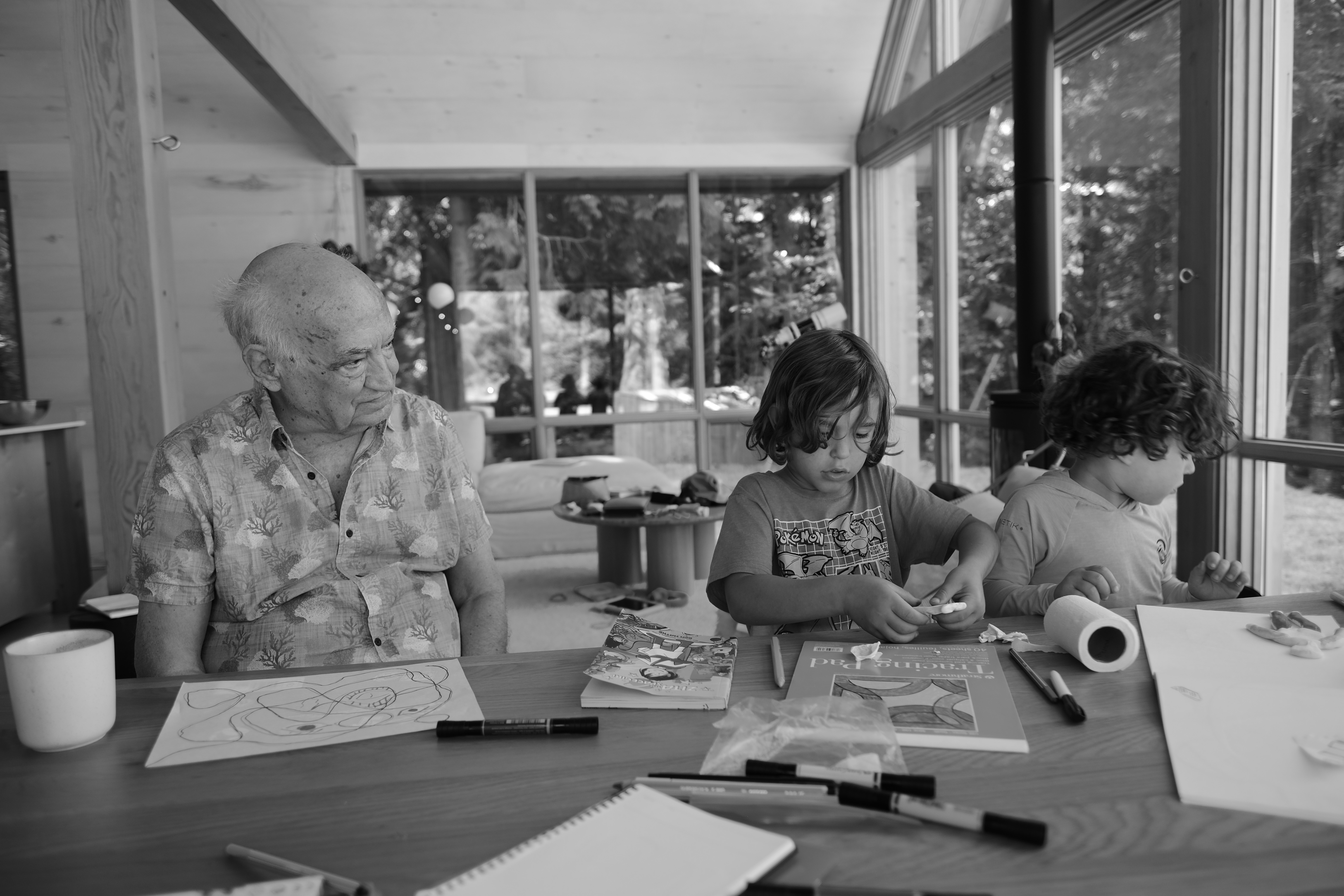
Vale's sentences come out like abstract art, consonants still finding their way around his tongue. Grandpa's hearing aid seems to be on a lunch break, his responses often veering into conversational territories uncharted by GPS. He even strays into Farsi, looking at me for just-in-time support.
Holden, my 7-year-old, jumps in occasionally, like a network engineer patching holes in their fragmented exchange. I notice him capturing lost packets of information, re-crafting them for improved accessibility, and helping with the last-mile delivery.
I repeatedly find myself wanting to jump in, trying to “help” by clarifying what is being said. But the trees outside remind me how small I am, so I stay quite, expecting one or both parties to give up. I know the laws of information density and fidelity, and this low-fidelity exchange is surely increasing the interpretation workload for each of them. The “meaning” will get lost, they will have to repeat themselves, there will be misunderstandings, and they will give up.
But they don’t.
It's messy. It’s unpredictable. And for them, it works.
How is this possible?
Wittgenstein once said, "the meaning of a word is its use in the language." If he could see this, he'd probably nod sagely and mutter, "Exactly, you fools." Because what's happening here isn't about words in a dictionary. It's about life, raw and unfiltered. It's a "language game" where the rules are made up on the fly and the points don't matter.
Not one bit. 1
They've created their own world, their own "form of life" as Wittgenstein would say. A world where meaning isn't found in grammatical perfection, but in the shared act of trying to connect. It all melts away in the face of pure, unfiltered human connection, facilitated by stringing words, as imperfectly sequenced as they sometimes are.
Which reminds me of reading poetry.
Poetry, often regarded as a high art form, presents an intriguing paradox in communication. While poets strive for precision in language and form, the very nature of poetry invites multiple interpretations. This multiplicity of meanings doesn't diminish the poem's communicative power; rather, it enhances it.
The beauty of poetry lies not in its ability to convey a single, clear message, but in its capacity to evoke a range of emotions and ideas that resonate differently with each reader. Maybe true connection isn't about achieving perfect clarity.
Think about it. The pressure to always say the "right" thing. The fear of being misunderstood. We burn more calories than needed, fearing language policing and purity testing. This hasn’t led to “easier” or better communication; quite the opposite.
Both poetry and intergenerational interactions remind us that perfect comprehension isn't always necessary for meaningful communication. The 'low fidelity' aspects - multiple interpretations in poetry or imperfect verbal exchange between generations - don't hinder communication. Instead, they create a richer, more nuanced form of interaction that captures the complexity of human experience.
An experience that I am fortunate to witness, across three generations.
Messy.
Imperfect.
And utterly, breathtakingly human.
That’s a dad joke, referencing the “packet loss” above. Bit. Get it? ↩
